

Open-Plan Living: Is It Still Worth It in 2026?
For decades, open-plan living has been one of the most popular home design trends. Removing walls between the kitchen, dining, and living areas promised brighter spaces, better social interaction, and a modern feel. But as lifestyles evolve—especially after the rise of remote work and changing family dynamics—many homeowners and designers are asking a new question: Is open-plan living still worth it in 2026?
The answer isn’t as simple as yes or no. Instead, today’s design trends show a shift toward flexible, hybrid spaces that balance openness with privacy.
Why Open-Plan Living Became So Popular
Open-plan layouts became mainstream because they solved several common problems in traditional homes.
First, they maximize natural light. Removing interior walls allows sunlight to flow across larger areas, making homes feel brighter and more spacious.
Second, they encourage social interaction. In an open layout, someone cooking in the kitchen can still interact with guests in the living room or watch children playing nearby.
Third, open plans create a sense of modernity and flow. Many homeowners love the seamless transition between spaces, which makes homes feel larger than their actual square footage.
For entertaining and family gatherings, open layouts remain highly practical.
The Downsides That Homeowners Are Noticing
Despite its popularity, open-plan living has revealed some limitations over time.
One major issue is noise. Without walls, sounds from cooking, television, conversations, and appliances can travel freely across the entire space.
Another concern is lack of privacy. With more people working from home, quiet areas for meetings or focused work have become essential.
There’s also the challenge of mess visibility. In an open layout, a cluttered kitchen is immediately visible from the living or dining area, which can make maintaining a tidy space more demanding.
These drawbacks have led many homeowners to rethink completely open interiors.
The 2026 Trend: “Broken-Plan” Living
Rather than abandoning open layouts entirely, designers are embracing a concept known as broken-plan living.
Broken-plan spaces maintain openness but introduce subtle divisions using design elements such as:
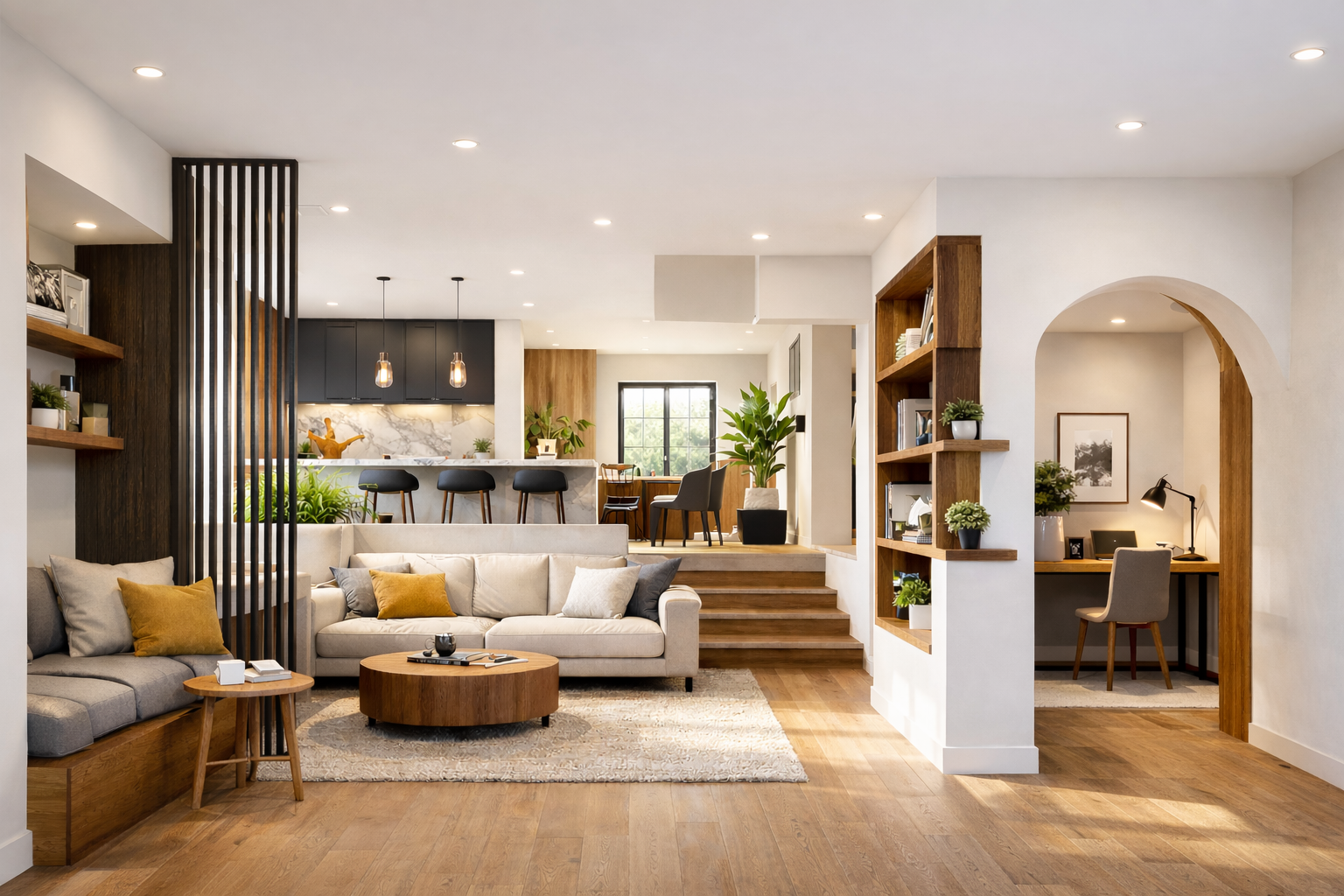
Glass partitions
Sliding or pocket doors
Open shelving units
Half-walls or room dividers
Changes in flooring or ceiling height
These features create visual separation without fully closing off spaces, offering the best of both worlds.
For example, a glass partition can block kitchen noise while still allowing light to pass through, preserving the airy feel of an open plan.
Smart Zoning Is the Key
In modern homes, the goal is no longer just openness, it’s intentional zoning.
Designers are focusing on defining different areas within a shared space. This can be achieved through:
Strategic furniture placement
Area rugs to anchor zones
Lighting variations for each function
Built-in cabinetry or partitions
These techniques help a space feel organized and purposeful without relying on solid walls.
When Open-Plan Still Works Best
Despite evolving trends, open-plan living still works exceptionally well in certain situations.
It remains ideal for:
Small homes or apartments that benefit from visual spaciousness
Families with young children, where supervision is important
People who entertain frequently
Homes with large windows and views, where openness enhances the connection to the outdoors
In these cases, open layouts can dramatically improve how a home feels and functions.
When a More Structured Layout May Be Better
However, homes designed today often benefit from a bit more separation. Structured layouts are better for:
Remote workers needing quiet spaces
Larger households with multiple simultaneous activities
People who prefer a calmer, less noisy environment
Homes where kitchen mess should stay out of sight
Many architects now recommend semi-open layouts rather than fully open ones.
The Future of Open Living
Open-plan living isn’t disappearing, it’s simply evolving.
The homes of 2026 are moving toward adaptable spaces that can shift between openness and privacy when needed. Sliding panels, modular furniture, and flexible partitions allow homeowners to change the feel of a room depending on the situation.
Instead of choosing between open or closed layouts, modern design is about finding the right balance.
Final Thoughts
So, is open-plan living still worth it in 2026?
Yes, but not in its original form. The best homes today combine the spaciousness of open layouts with thoughtful design elements that introduce privacy, comfort, and functionality.
In other words, the future of home design isn’t fully open or fully closed. It’s smartly connected spaces that adapt to modern life.